
AI workflow automation is becoming essential for solo creators who want to publish consistently without burning out. Instead of manually managing research, writing, repurposing, SEO, and scheduling, creators now use AI workflow automation systems to simplify repetitive tasks and focus more on creative thinking.
There’s a strange moment most solo creators hit.
You realize you’re spending more time managing content than actually creating it.
You open 17 tabs.
Your Notes app looks like a digital junk drawer.
Pinterest ideas disappear.
Half-written Medium drafts pile up.
Your posting schedule becomes “whenever I survive the week.”
And suddenly, the dream of creative freedom starts feeling suspiciously like unpaid admin work.

That’s exactly where AI workflow automation changes the game.
Not because AI magically replaces creativity.
It doesn’t.
It removes the repetitive friction surrounding creativity. AI workflow automation tools help creators reduce repetitive work.
For beginner content creators, students, Gen Z side hustlers, and anyone trying to build online income while juggling real life, this matters more than productivity hacks ever did.
Because the real bottleneck isn’t talent anymore.
It’s operational overwhelm.
Table of Contents
Why Most Content Workflows Collapse
Most creators don’t fail because they lack ideas.
They fail because their systems are unsustainable.
Especially beginners.
They try to:
- Post daily on multiple platforms
- Write long-form blogs
- Make Pinterest graphics
- Edit short videos
- Respond to comments
- Research trends
- Learn SEO
- Monetize everything immediately
All manually.
That works for maybe two weeks.
Then burnout arrives disguised as “I need a break.”
The Hidden Problem Nobody Talks About
Content creation today isn’t one job.
It’s actually six jobs:
- Researcher
- Writer
- Designer
- Video editor
- SEO strategist
- Distribution manager
Big media companies split these into departments.
Solo creators try to do all six before lunch.
That’s why AI workflow automation isn’t optional anymore for creators trying to grow consistently.
It’s infrastructure.
My Old Workflow Problem

My original workflow was chaotic. I was trying to create separate content for Medium, Pinterest, YouTube Shorts, and affiliate posts every day.
Every platform felt like starting from zero.
I’d research a topic on Google.
Write a blog from scratch.
Then manually think of Pinterest titles.
Then try turning the same idea into short-form content.
By the end of the day, I was exhausted — and still inconsistent.
The worst part?
I wasn’t even spending most of my time creating quality content.
I was:
- Reformatting
- Rewriting
- Searching for ideas
- Organizing notes
- Switching between apps
- Forgetting good concepts
The mental load became heavier than the actual work.
That’s where AI workflow automation became less about “working faster” and more about protecting creative energy.
The AI Research System
Most creators use AI incorrectly.
They open ChatGPT and ask for “10 blog ideas.”
That’s surface-level usage.
The real advantage comes from building a connected research system.
Here’s the workflow that changed everything for me.
Step 1: Use Google Trends to Validate Interest
Before writing anything, I check whether people are actively searching for the topic.
Tools like Google Trends help identify:
- Rising searches
- Seasonal spikes
- Emerging creator topics
- Regional interest
- Long-tail keyword opportunities
Instead of guessing what people want, you’re reading demand signals directly.
That alone cuts wasted content time dramatically.
Smart Creator Insight
Most beginner creators create content based on inspiration.
Growing creators create content based on patterns.
That shift matters.
Step 2: Use Pinterest Trends for Visual Demand
Pinterest is underrated for creator research.
Especially for:
- Productivity
- AI tools
- Blogging
- Side hustles
- Study systems
- Personal growth
Pinterest Trends reveals what people are saving, searching, and planning for weeks before trends explode elsewhere.
This is valuable because Pinterest users often represent future intent.
Someone searching:
- “AI workflow setup”
- “creator organization”
- “content systems”
…is likely preparing to take action soon.
That’s commercial intent hiding inside inspiration.
Step 3: Organize Research with NotebookLM
This is where most creators still waste time.
They collect information everywhere:
- screenshots
- bookmarks
- random tabs
- voice notes
- unfinished docs
Then they can’t find anything later.
NotebookLM changes this.
You can upload:
- PDFs
- blog drafts
- research docs
- transcripts
- notes
Then ask AI questions directly about your own knowledge base.
This reduces mental clutter massively.
Instead of constantly re-researching topics, you build a searchable idea library.
Step 4: Use ChatGPT as a Workflow Engine

Most creators use AI like a vending machine.
Smart creators use it like an operating system.
ChatGPT helps automate:
- outlines
- SEO structures
- title variations
- hooks
- FAQs
- content repurposing
- email drafts
- Pinterest copy
- affiliate comparisons
But here’s the key:
AI works best when you already have direction.
Bad input creates generic content.
Strong systems create scalable content.
That’s the difference.
My Writing Workflow
This is the simplest workflow I’ve found that consistently reduces stress.
Not the fanciest.
Just the most sustainable.
1. Outline First
I never start writing paragraphs immediately anymore.
That used to waste hours.
Now I begin with:
- headline ideas
- search intent
- emotional pain points
- subheadings
- audience objections
- SEO keywords
Once the structure exists, writing becomes dramatically easier.
Think of it like building rails before driving the train.
2. Expansion Second
After the outline is clear, AI helps expand sections faster.
But I never publish raw AI output.
That’s where many beginner creators destroy trust.
Instead, I:
- add personal examples
- rewrite robotic phrasing
- inject opinions
- simplify explanations
- improve emotional flow
Readers don’t connect with information alone.
They connect with recognition.
They want to feel:
“This person understands exactly what my workflow feels like.”
That emotional specificity is what separates memorable content from disposable content.
3. Reuse Everywhere
This changed everything.
Most creators accidentally create new work for every platform.
That’s unsustainable.
Instead, one core idea becomes multiple assets.
For example:
One blog post becomes:
- Pinterest pins
- email newsletter
- Medium article
- LinkedIn post
- Threads content
- YouTube Shorts script
The core thinking stays the same.
Only the packaging changes.
How I Repurpose One Blog Into 6 Pieces of Content
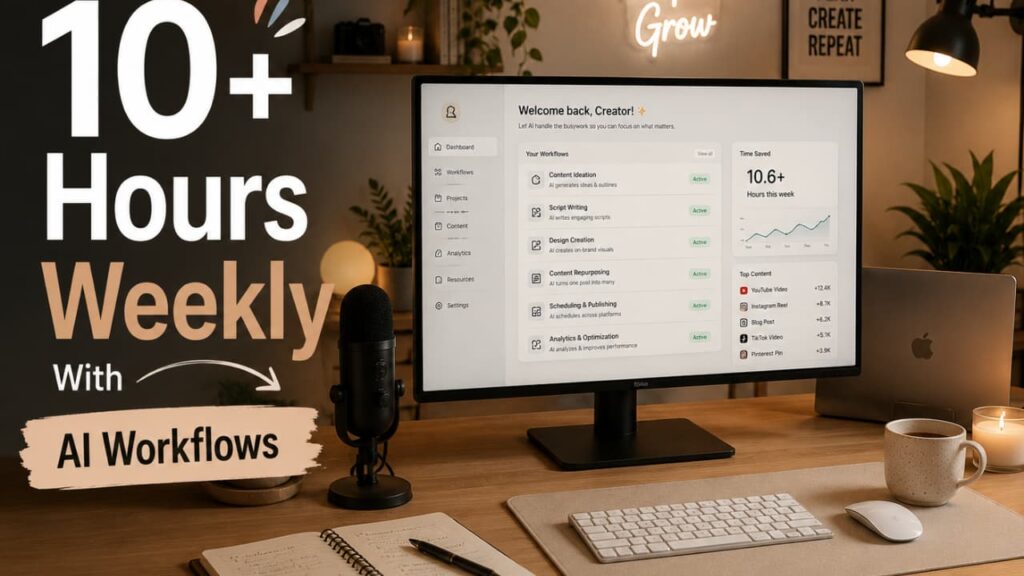
This is where AI workflow automation saves the most time.
And honestly, most creators still underestimate this section completely.
Because content creation isn’t the bottleneck anymore.
Distribution is.
The Old Way
Write:
- 1 blog
- 1 Instagram caption
- 1 Pinterest post
- 1 email
- 1 Twitter thread
- 1 short-form script
Separately.
That’s exhausting.
The New Workflow
Now I create one “pillar” piece of content first.
Usually:
- a blog post
- deep guide
- opinion article
- tutorial
Then AI helps atomize it.
Content Repurposing System
Blog → Pinterest Pins
AI generates:
- curiosity hooks
- title variations
- benefit-driven text overlays
Example:
- “The AI System Saving Me 10 Hours Weekly”
- “My Creator Workflow Before vs After AI”
- “How Small Creators Scale Without Burnout”
Blog → Medium Article
Medium audiences prefer:
- storytelling
- insight-driven writing
- cleaner formatting
So I adapt:
- shorter intro
- fewer SEO-heavy sections
- stronger emotional narrative
Same core idea. Different reader psychology.
Blog → YouTube Shorts Script
AI extracts:
- strongest hook
- fastest insight
- tension points
- curiosity gaps
Example:
“Most creators don’t need more motivation. They need fewer repetitive tasks.”
That’s a Shorts opener immediately.
Blog → Email Newsletter
The email version becomes more personal.
Usually:
- one insight
- one lesson
- one mistake
- one recommendation
Simple performs better than overloaded newsletters.
Blog → Affiliate Content
This is where automation becomes financially useful.
Instead of randomly recommending tools, you naturally integrate them into workflows.
For example:
- AI writing tools
- SEO software
- scheduling apps
- note systems
- automation platforms
That creates contextual affiliate opportunities instead of forced promotions.
Blog → Social Threads
Threads and LinkedIn reward:
- concise opinions
- relatable creator struggles
- mini frameworks
AI helps condense:
2500 words → 12 strong short-form points.
That’s leverage.
Tools I Use Daily
Most creators overcomplicate tool stacks.
You do not need 37 subscriptions.
You need:
- one research system
- one writing system
- one organizational system
- one publishing system
That’s it.
Here’s a practical setup.
Research Tools
Google Trends
Best for:
- keyword validation
- trend timing
- topic demand
Pinterest Trends
Best for:
- visual content demand
- lifestyle niches
- seasonal planning
AnswerThePublic
Best for:
- question-based SEO ideas
- long-tail keywords
- audience pain points
Writing Tools
ChatGPT
Best for:
- outlines
- repurposing
- workflow automation
- ideation
Grammarly
Best for:
- readability
- editing
- clarity improvements
Organization Tools
Notion
Best for:
- content calendars
- databases
- creator systems
NotebookLM
Best for:
- AI-assisted research organization
- searchable idea storage
Automation Tools
Zapier
Best for:
- automating repetitive tasks
- connecting apps
Make
Best for:
- advanced creator workflows
- visual automations
Mistakes Beginners Make
AI helps speed things up.
But it also magnifies weak systems.
These are the biggest mistakes beginner creators make.
Mistake #1: Publishing Raw AI Content
Readers can feel generic writing immediately.
It lacks:
- lived experience
- emotional detail
- strong opinions
- human rhythm
AI should accelerate thinking — not replace perspective.
Mistake #2: Automating Too Early
Some creators try automating before understanding their audience.
Bad idea.
You should manually create enough content first to understand:
- what resonates
- what gets clicks
- what keeps attention
- what converts
Automation works best after patterns appear.
Mistake #3: Creating for Every Platform Daily
This destroys consistency.
Better approach:
- one core platform
- one secondary distribution channel
- one repurposing system
That’s sustainable.
Mistake #4: Treating Productivity Like Creativity
This is subtle but important.
More output doesn’t automatically create better content.
Some creators optimize speed so aggressively that their content becomes emotionally flat.
Efficiency matters.
But resonance matters more.
Expert Tips Most Creators Learn Too Late
Build Assets, Not Posts
A searchable blog compound.
Random social posts disappear.
That’s why long-form SEO content still matters in 2026.
One strong article can:
- rank for months
- generate affiliate income
- build authority
- feed multiple platforms
Short-form content attracts attention.
Long-form content builds digital property.
Reduce Context Switching
This alone can save hours weekly.
Instead of:
- writing
- researching
- editing
- designing
…all in the same hour, batch similar tasks together.
For example:
- Monday → research
- Tuesday → writing
- Wednesday → repurposing
- Thursday → scheduling
Your brain performs better with fewer mode changes.
Your Workflow Should Protect Energy
Most productivity advice ignores emotional fatigue.
But creators don’t quit because calendars failed.
They quit because the process becomes psychologically exhausting.
A good AI workflow should make content feel:
- lighter
- clearer
- repeatable
- less mentally noisy
That’s the real metric.
My Current Minimal-Stress Workflow
Right now, my workflow is intentionally simple.
Because complexity looks impressive online but collapses under real life.
Here’s the current system:
Weekly Workflow
Step 1: Research Trends
- Google Trends
- Pinterest Trends
- audience questions
Step 2: Create One Core Article
- SEO optimized
- evergreen angle
- deep value
Step 3: Repurpose Into Smaller Assets
- short-form
- Threads
- Medium
Step 4: Schedule Everything
- batch uploads
- reduce daily pressure
Step 5: Repeat
That’s it.
No content chaos.
No constant scrambling.
No reinventing the wheel daily.
And the biggest surprise?
The simpler the workflow became, the more consistent growth improved.
Because sustainable systems outperform motivational bursts.
Every time.
FAQ: AI Workflow Automation for Solo Creators
What is AI workflow automation for creators?
AI workflow automation helps creators reduce repetitive tasks using tools powered by artificial intelligence. This includes research, outlining, repurposing, scheduling, SEO optimization, and organization.
Can beginners use AI automation effectively?
Yes — but beginners should avoid over-automation early. Learn audience behavior first, then automate repetitive processes gradually.
How many hours can AI workflow automation realistically save?
For solo creators, 5–15 hours weekly is realistic depending on:
- publishing frequency
- number of platforms
- existing workflow chaos
The biggest savings usually come from repurposing content efficiently.
Does AI-generated content hurt SEO?
Low-quality generic AI content can hurt performance.
But high-quality human-edited AI-assisted content can perform extremely well when it:
- matches search intent
- adds originality
- includes experience
- solves real problems
Google prioritizes usefulness, not whether AI assisted the process.
Which AI tools are best for content creators?
Popular options include:
- ChatGPT
- NotebookLM
- Notion AI
- Grammarly
- Zapier
- Make
The best stack depends on your workflow complexity and content goals.
Should creators focus on SEO or social media first?
SEO builds long-term traffic assets.
Social media builds faster visibility.
The strongest strategy combines both:
- long-form searchable content
- short-form distribution content
That creates compounding reach.
Final Thoughts
Most solo creators don’t actually need more discipline.
They need fewer unnecessary decisions.
That’s what smart AI workflow automation solves.
Not creativity.
Not originality.
Not voice.
Just the repetitive operational drag surrounding modern content creation.
The creators growing fastest right now aren’t necessarily working harder.
They’re building systems that protect:
- focus
- energy
- consistency
- momentum
And in the long run, sustainable creators almost always outperform overwhelmed creators.
CTA
What part of your current content workflow wastes the most time right now?
Research? Writing? Repurposing? Organization?
Drop a comment below — or share this article with another creator drowning in content chaos.
Sometimes, one better system changes everything.